Excalibur: The Galactic Journey
Chapter 1: Into the Deep
Part 1: The Outer Rim
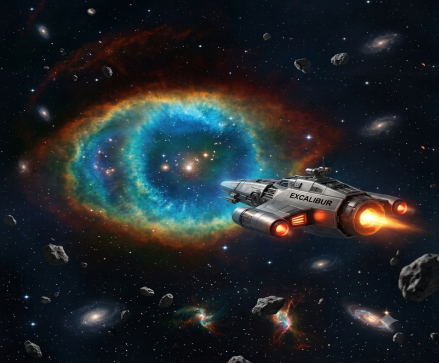
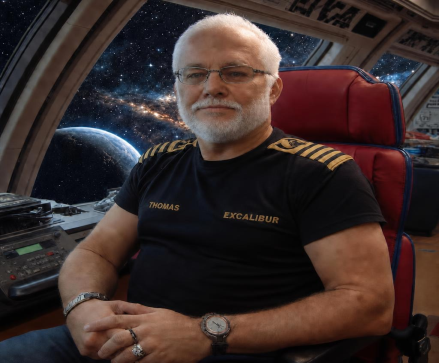
The thrusters of the Excalibur didn't roar; they hummed—a low, rhythmic pulse that echoed through the sole occupant's boots. Built compact, sleek, and crammed to the bulkheads with sensor arrays and long-range scanners, the craft was less of a flagship and more of a tin can with an FTL drive. But to Captain Cade Thomas, it was home, laboratory, and key to the open universe.
"Excalibur to Deep-Space Control," Cade murmured into his comms mic, watching the blue-and-rust marble of Earth shrink in the forward viewport. "Departing Sector 4. Clearing the rim."
A crackle of static answered, followed by a voice miles away: "Copy, Excalibur. Fair winds out there, Cade. Remember, you’re off the map past the Sol System."
"That's the point," Cade said with a faint smirk.
He punched the sequence into the primary nav-console. The Excalibur had been engineered for one purpose: solitary exploration. Where massive fleet cruisers moved with the grace of glacial ice, the small ship could slip into dense nebula fields, weave through unmapped asteroid belts, and skim the upper atmospheres of alien worlds without kicking up a fuss.
Inside the tiny cabin, every inch of space was utilized. Stash drawers held rations and repair kit spares; the pilot’s chair reclined into a bunk; and above the main dash, a blue holographic sphere spun slowly, displaying a map that was mostly blank void waiting to be filled.
"Alright, old girl," Cade muttered, tapping the glass of the main drive gauge. "Let's see what’s out there."
With a sudden, seamless shift in inertia, the stars outside stretched into brilliant ribbons of silver light. The Excalibur lurched forward, jumping past the known charts and into the quiet, vast unknown.
The galaxy was not quiet, Cade quickly discovered—it was loud with energy.
For twelve weeks, the Excalibur had been weaving through the Orion Spur, recording phenomena human eyes had never witnessed. Cade had logged binary stars locked in a slow, cosmic tango, a rogue ice planet glowing with bioluminescent crustacean life beneath ten miles of frozen methane, and a cloud of ionized dust that hummed on radio frequencies like a choir.
Tonight, though, the scanners chimed with a crisp, double-tone.
"What do we have?" Cade leaned forward, coffee bulb hovering near his elbow.
The sensor suite displayed a massive, swirling expanse of violet and gold—a cradle nebula, dense with newborn stars. But buried deep within the radiant dust, the ship's grav-detectors registered an anomaly: a perfectly smooth, non-natural sphere drifting silent and cold.
"Auto-pilot off," Cade said, taking the manual flight sticks.
The Excalibur darted into the violet mist like an arrow. Dust particles pinged gently against the reinforced forward hull. As the cloud thinned, the object came into view. It was an ancient, deserted relay station—overgrown with crystal formations that absorbed and refocused the light of the nearby infant stars, creating a slow, rhythmic beam that pulsed into deep space.
Cade mapped the structure, recording its energy signatures, age metrics, and coordinates. He wouldn't land—the Excalibur wasn't equipped to salvage heavy alien tech—but he was the first human to ever record its existence.
He uploaded the telemetry into the core log: Object 884-A. The Lantern of Orion.
"One more secret checked off," Cade said, leaning back as the ship slowly circled the glowing relic.
Later that evening, sitting in the warm amber light of the cockpit, Cade updated his journal. Outside, the galaxy spun in endless, breathtaking splendor—billions of suns, uncounted worlds, and infinite stories waiting to be read.
He looked at the small brass plaque riveted to the control dashboard. It bore a single sentence engraved before launch:
"To seek, to find, and not to yield."
Cade engaged the sub-light engines, steering the Excalibur away from the glowing nebula and back toward the dark space beyond. One man, one small ship, and a whole universe left to map.
Part 2: Ghost Signal
The Excalibur glided smoothly away from the radiant violet dust of the cradle nebula, leaving the Lantern of Orion behind to pulse its silent, ancient beacon into the void.
Cade leaned back in the pilot’s chair, watching the starlight normalize on the forward viewport. He unclipped his water pouch, took a slow sip, and reached out to set the nav-computer for the long burn toward the Perseus Arm.
BEEP-BEEP. BEEP-BEEP.
A sharp, double-tone cut through the quiet hum of the thrusters. It wasn't the ambient radiation alarm, nor was it the usual sensor chirp for space debris. It was the high-frequency array—the channel meant for emergency transponders.
Cade’s thumb hovered over the drive engagement button. He froze, listening.
BEEP-BEEP. BEEP-BEEP.
"Computer, isolate audio line three," Cade said, pulling the flex-mic closer to his mouth. "Filters on cosmic background interference."
The static dissolved into a crisp, rhythmic pulse. But it wasn't a standard Earth-bound Mayday. There was no vocal recording, no distress standard beacon ping, and no beacon registration code. Instead, it was a sequence of rapid, mathematical chirps—a series of prime numbers repeating every eight seconds.
Two. Three. Five. Seven. Eleven.
"Where is that coming from?" Cade murmured, his fingers dancing across the glass touch panel of the long-range sensor suite.
A red vector line snapped into existence on the holographic map floating above the dash. The signal wasn't originating from open space; it was bouncing off the crystal structure of the Lantern of Orion, using the ancient relay's energy beam like a mega-amplifier to broadcast across light-years.
The source was three parsecs out, tucked inside a dead, unmapped system designated only as G-774.
Cade stared at the flashing red dot on the display. Protocol for a solo deep-space exploratory vessel was clear: document all unregistered radio activity, tag the coordinates, and forward the data back to Deep-Space Control at the next comm-relay jump. Solo ships were too small, too lightly armored, and too isolated to play hero.
He looked over at the bulkhead. A small photo was tucked into the frame of the comms rig—a reminder of home, of the endless, structured routine of Earth's local orbits. But Earth was months behind him now.
"If I send this back to Control, a heavy cruiser won't get here for two years," Cade said aloud to the empty cabin.
He tapped the drive console, overriding the auto-pilot's jump trajectory to the Perseus Arm.
"Excalibur log entry," Cade said, pulling the flight yoke toward him. "Intercepting a non-human mathematical broadcast originating from System G-774. Altering course to investigate."
The Excalibur pivoted on its maneuvering thrusters, its sleek nose aligning with the distant, dim speck of G-774's dying red dwarf star. With a low surge of power from the sub-light core, the small ship shot into the dark, chasing a ghost signal into the deep.
Part 3: The First Discovery
System G-774 was a graveyard of red twilight.
A dying red dwarf star cast a faint, bruised crimson glow across the debris field cluttering the system's inner orbit. The Excalibur picked its way carefully through the cloud of shattered rock, its deflector shields humming as micro-asteroids pinged harmlessly off the bow.
"Signal origin locked," Cade said, adjusting the visual sensors on the main viewscreen. "It's coming from the shadow of the third planet's moon."
The moon was a scarred, desolate rock, pitted by millennia of impacts. But as the Excalibur rounded its dark side, the sensors lit up. Basking near the faint thermal vents of a massive crevasse below was a ship.
It wasn't human. Sleek, iridescent, and shaped like a tapered crescent, it lay half-buried in moon-dust, dark and silent except for a single glowing amber strip running along its dorsal hull.
Two. Three. Five. Seven. Eleven.
The signal wasn't a broadcast to the galaxy—it was an automated locator beacon, pulsing feebly as the ship's remaining reserve power bled out.
Cade brought the Excalibur into a stable hover fifty meters above the alien craft. His heart hammered a steady rhythm against his ribs. First contact protocols flashed across his mind, but there was no protocol for a solo explorer stumbling upon a derelict alien ship in deep space with no backup for light-years.
"Scans show atmospheric seal intact on the upper deck," Cade muttered, snapping his suit helmet into place and checking the pressure seals. "No power signatures other than the beacon."
He locked the flight controls, grabbed his multi-tool kit, and stepped into the environmental airlock.
"Excalibur log," Cade said into his helmet mic, his voice steady despite the adrenaline surging through his veins. "Initiating boarding sequence on unidentified alien vessel, System G-774. If anyone's reading this down the line... wish me luck."
The airlock hissed open, exposing the dark, silent surface of the moon below. Cade Thomas took a breath, stepped out into the void, and crossed the threshold into history.
Chapter 2: The Map of Constellations
Part 1: Echoes in the Dark
The boots of Cade’s suit touched down with a soft thud against the alien ship’s dorsal hull. Magnetic locks engaged instantly, anchoring him to the iridescent surface. Beneath his soles, he could feel a microscopic vibration—the faint, dying heartbeat of a power core on its last legs.
Up close, the ship was a marvel. The hull wasn't made of welded metal plates or composite polymers; it looked like grown obsidian, seamless and faintly warm through his suit's thermal sensors.
Cade moved toward what appeared to be an airlock iris near the upper bridge. He unslung his multi-tool, setting the frequency to match the energy signature of the amber locator beacon.
"Alright, let's see if we speak the same language," Cade whispered.
He directed a low-frequency pulse at the airlock's housing. For three long seconds, nothing happened. Then, with a sound like smooth glass sliding over silk, the obsidian iris dilated open, revealing a short entry chamber bathed in dim, amber light.
Cade stepped inside. The moment he crossed the threshold, the outer iris sealed shut behind him, and the chamber hummed to life. Sensors on his wrist display spiked.
Atmosphere: Nitrogen-Oxygen mix. Pressure: 0.9 ATM. Temperature: 4°C.
"It's breathable," Cade muttered, unclipping his helmet seals, though he kept the visor down. "Someone built this to keep something alive."
He stepped out of the airlock and into the main cabin. Unlike the dense, functional clutter of the Excalibur, this ship was minimalist, almost organic. Swirling archways opened into wider chambers, and control consoles curved gracefully out of the deck plating like dark glass sculptures.
And then he saw it.
In the center of the bridge, suspended inside a pale blue column of stasis light, was a pedestal. Resting upon it was not an alien pilot, nor a weapon, but a glowing, intricate sphere—no larger than a grapefruit, covered in shifting, geometric runes.
As Cade approached, the sphere's light flared gently, matching the rhythm of his own heartbeat.
"Excalibur, are you recording this?" Cade asked into his comms.
A layer of static washed over the earpiece, followed by his ship's automated AI voice, faint and distorted by the moon's mineral crust: "Telemetry received, Captain. Object displays high-density data storage signatures... non-human origin."
Cade reached out a gloved hand. Just an inch from the stasis field, the sphere suddenly stopped spinning. The geometric runes aligned, and a holographic projection burst upward into the dim cabin, filling the space with a sweeping star map of a galaxy Cade had never seen—vast, ancient, and marked with thousands of uncharted transit routes.
Cade stared at the shimmering map in awe. "You're not a distress beacon..." he realized softly. "You're a star map to somewhere else."
Part 2: The Awakening
The holographic map flared brighter, casting complex constellations across Cade’s visor and lighting up the obsidian walls of the alien bridge.
Cade pulled out his scanner, capturing as much telemetry as he could from the projection. "Excalibur, do you copy? I've got a full cartographic array here—looks like intergalactic transit vectors."
Static crackled sharply in his ear, followed by an urgent chime from the Excalibur’s proximity sensor network.
"Captain," the automated AI voice warned, distorted by electromagnetic noise. "Detecting a massive energy spike beneath the moon's crust. Seismic activity increasing."
The deck floor beneath Cade’s boots gave a sudden, violent shudder. Dust cascaded from the ribbed arches above.
Down in the dark depths of the moon’s crevasse, a deep, resonant rumble echoed—a low sound that vibrated straight through his suit. The amber lights along the alien ship’s walls shifted to a pulsing, ominous crimson.
The ship wasn't just sitting idle on a dead moon; it was anchored to a subterranean power station. And touching the sphere had woken the whole system up.
"Excalibur, get ready for immediate liftoff," Cade said, stepping closer to the pedestal.
The stasis column holding the glowing sphere flickered. The mathematical runes on its surface began spinning at blinding speeds, and the holographic map collapsed back into the core with a soft snap.
Outside the viewport, the lunar surface cracked open. Geysers of superheated ionized gas erupted from the fissure, bathing the alien ship in blinding white light.
Cade reached into his harness, unclipping a containment canister from his belt. "If this moon goes, this map goes with it."
He reached his gloved hands directly into the fading stasis field, taking hold of the alien sphere.
Part 3: Race Against the Dark
The moment Cade’s fingers clamped around the sphere, a jolt of static raced up his arms, making his teeth chatter inside his helmet. The orb was unexpectedly light, humming with a kinetic charge that almost vibrated out of his grip.
CRACK.
The obsidian deck tilted violently as the moon's surface split beneath the alien ship. The far side of the cabin buckled, hull plates tearing like paper as superheated gas surged through the lower decks.
"Cade to Excalibur!" he yelled over the roar of escaping pressure, shoving the sphere into his insulated containment pouch and slamming the hatch shut. "Bring her down to fifty feet! I'm coming out!"
"Warning," the Excalibur’s automated voice cut through the static, clipped and urgent. "Local gravitational field is collapsing. System instability at critical."
Cade bolted for the airlock iris. It snapped open just as the rear section of the alien vessel slid backward into the widening abyss.
He didn't wait for the cycling sequence. Cade hit the emergency override, blowing the seals, and hurled himself out into the vacuum of space.
Below him, the ruined moon was breaking apart. Crimson lava and ionized plasma shot into the sky like fireworks, illuminating the pitch-black void. The alien ship was already halfway swallowed by the growing rift.
Above, the sleek silver hull of the Excalibur dropped through the debris cloud, her maneuvering thrusters firing in short, aggressive bursts to hold steady amidst the gravity well.
"Fifty meters... thirty meters..." Cade monitored his suit’s thruster pack, firing his remaining RCS fuel to intercept his ship.
A chunk of lunar rock the size of a shuttle swept past, missing his boots by yards. The turbulence hit him, spinning him out of control. The starfield blurred—black, red, silver, black.
"Come on, hold together..."
Cade fired his left-side thruster full bore, stabilizing his spin just long enough to reach out. His magnetic glove slammed onto the Excalibur’s ventral airlock ladder.
Clang.
He pulled himself inside, hit the cycle button, and sealed the hatch behind him.
The second the inner door unlocked, Cade scrambled to the pilot's chair without even stripping off his suit. He grabbed the flight sticks, jammed the main sub-light throttles straight to maximum, and disengaged the magnetic docks.
"Hang on, old girl!"
The Excalibur lunged forward, her main engines roaring to life with a deep, full-throated pulse. Outside the viewports, the moon collapsed inward on itself, triggering a localized spatial shockwave that hit the ship from behind like a sledgehammer.
The hull groaned. Alarms blared across the dash—amber warnings flashing for deflector shield overload and structural stress. But the Excalibur held. She surged clear of the exploding debris, shooting past System G-774’s dying red dwarf and breaking out into the safety of deep, open space.
Silence restored itself to the cockpit.
The warning lights faded back to a calm, steady green. Out the aft viewport, the cloud of pulverized rock was already dispersing into the void.
Cade collapsed back in his seat, breathing heavily, his chest rising and falling in the quiet cabin.
He unclipped the containment canister from his belt and set it gently on the console deck. He unlatched the top.
The sphere rested inside, glowing with a calm, rhythmic pulse of blue light—safe, sound, and carrying the coordinates to an entire unmapped galaxy.
Cade smiled, wiping a bead of sweat from his forehead. "Not bad for a Tuesday."
Chapter 3: The Crossroads
Part 1: Unlocking the Grid
The quiet hum of the Excalibur’s sub-light drive was a comforting balm after the chaotic collapse of System G-774's moon.
Cade sat at the central worktable in the ship’s compact research bay, his suit jacket draped over the back of his chair. The alien sphere floated inside a localized containment grid on the table, humming faintly as tiny fiber-optic cables connected its casing to the ship’s primary diagnostic console.
"Data bridge established," the ship’s AI reported softly. "Decrypting file structures... Captain, the data density exceeds standard star-chart protocols by several orders of magnitude."
"Translate it into standard navigational vectors," Cade said, leaning in close with a warm mug of coffee in hand. "Where is it pointing us?"
On the holographic projector, a dense web of light unfolded. Millions of glowing lines linked distant star systems across a completely unfamiliar sector of space. But one path burned brighter than the rest—a bold golden line that cut straight through a massive, unexplored dark-matter void on the outer edge of the Milky Way.
"Destination target: Unassigned," the AI stated. "Estimated transit distance: 14,000 light-years. Vector leads beyond all charted Federation space."
Cade stared at the glowing line. Fourteen thousand light-years. On standard FTL routes, a trip like that would take months of hopping between jump-gates. But the map didn't use standard routes—it laid out a shortcut, a localized corridor woven through the folds of slipstream space.
"Anything else hidden in that file?" Cade asked, noticing a blinking red symbol tucked into the fringe of the data packet.
"Affirmative. A repeating telemetry tag," the AI replied. "It appears to be a timestamp... or a countdown."
Cade's brow furrowed. "A countdown to what?"
Part 2: Ghost in the Static
"Countdown duration unknown," the AI responded, its synthesized voice echoing in the small workspace. "The sequence is decaying rapidly as the sphere’s power cell adjusts to our ship's grid."
Cade set his coffee mug down on the console edge. "Decaying? Meaning it was designed to run down, or..."
BEEP... BEEP... BEEP.
A sharp, irregular chime cut through the lab. It wasn't the nav-computer completing its transit calculations. It was the long-range sensor suite on the upper hull.
"Report," Cade said, stepping back toward the flight deck.
"Unidentified spatial distortion detected at the system edge," the AI announced. "Proximity: two AU and closing fast. Target is traveling without standard FTL signature."
Cade dropped into the pilot's chair and pulled up the long-range radar grid. A dark, jagged contact had just slipped into normal space at the fringe of System G-774. It was large—easily twice the tonnage of a deep-space exploration vessel—and sleekly contoured with radar-absorbent plating.
"They didn't track our warp trail," Cade realized, watching the thermal readout on the intruder. He turned his head back toward the research bay, where the alien sphere continued to pulse rhythmically inside its glass cage. "The timestamp... it was a homing signal."
"Target vessel is altering vector," the AI warned. "Intercept course locked on our current position. Arrival in four minutes."
"They aren't answering hailing frequencies, are they?"
"Negative, Captain. No comms emissions detected. Weapon systems on the approaching vessel are charging."
Cade stared at the glowing golden transit vector floating over the main navigation board—the 14,000-light-year shortcut laid out by the sphere. The path was unverified, calculated through an unstable slipstream corridor that no human drive had ever tested.
If the drive failed, the Excalibur would be torn apart by tidal forces in the fold between spaces.
If he stayed, a heavily armed dark-hull ship was four minutes away from turning his small craft into scrap and taking the map for themselves.
Cade slammed his hand down on the primary engine engage toggle, routing maximum power from the sub-light thrusters directly into the jump core.
"Lock the coordinates from the sphere," Cade ordered, gripping the flight sticks with both hands. "We're taking the shortcut."
Part 3: The First Jump
"FTL drive spooling," the AI announced, its voice calm against the rising whine of the ship's jump core. "Warning: Navigational parameters are non-standard. Slipstream stability is unverified."
"Override stability lock," Cade said, slamming his suit visor down. "Do it now!"
On the forward viewscreen, the dark pursuer broke through the dust clouds on a direct intercept path. Red energy pulses flared from its forward mounts—warning shots, or the first salvo of an opening strike. Space rippled around the incoming vessel as it bore down on the tiny craft.
"Jump core at one hundred percent," the AI chimed. "Engaging on alien coordinates."
The Excalibur didn't just warp—it felt as though the universe snapped like a stretched rubber band.
The starlight outside distorted into blinding, violet arcs. The ship shuddered violently, the hull groaning under the sheer pressure of entering a localized slipstream corridor. Console displays flickered wildly, lines of code crashing and rebooting as the alien sphere fed raw, unmapped spatial calculations directly into the ship's engine manifold.
Inside the cockpit, gravity went light, then heavy, then shifted sideways. Cade fought the flight sticks, keeping the nose aligned with the blazing golden vector projected across the viewport.
For three heart-stopping seconds, everything went silent. The pursuer vanished, the red space of System G-774 dissolved, and the Excalibur plummeted through a tunnel of swirling, iridescent light—a highway between stars that wasn't supposed to exist.
Then, with a concussive THUM, the slipstream released them.
The ship dropped back into real space with a heavy lurch, thrusters firing automatically to stabilize their momentum.
Cade exhaled a breath he hadn't realized he was holding, his hands trembling slightly on the controls. He looked up at the main viewport.
The red dwarf star was gone. The dark pursuer was gone.
Before them lay an entirely foreign expanse of the cosmos—a double-ringed nebula glowing in brilliant blues and emeralds, cradling a cluster of suns unlike anything recorded in Federation archives. Fourteen thousand light-years traversed in a single heartbeat.
A low chime sounded from the console. The alien sphere in the research bay flickered, its glowing runes shifting into a new, steady pattern.
Cade slowly unclipped his harness, a wide, awe-struck grin spreading across his face as he looked out at the unmapped sky.
"We made it," Cade whispered. "We're really off the map now."